
Quick answer
Choose the table from the bankroll, not the bankroll from the table
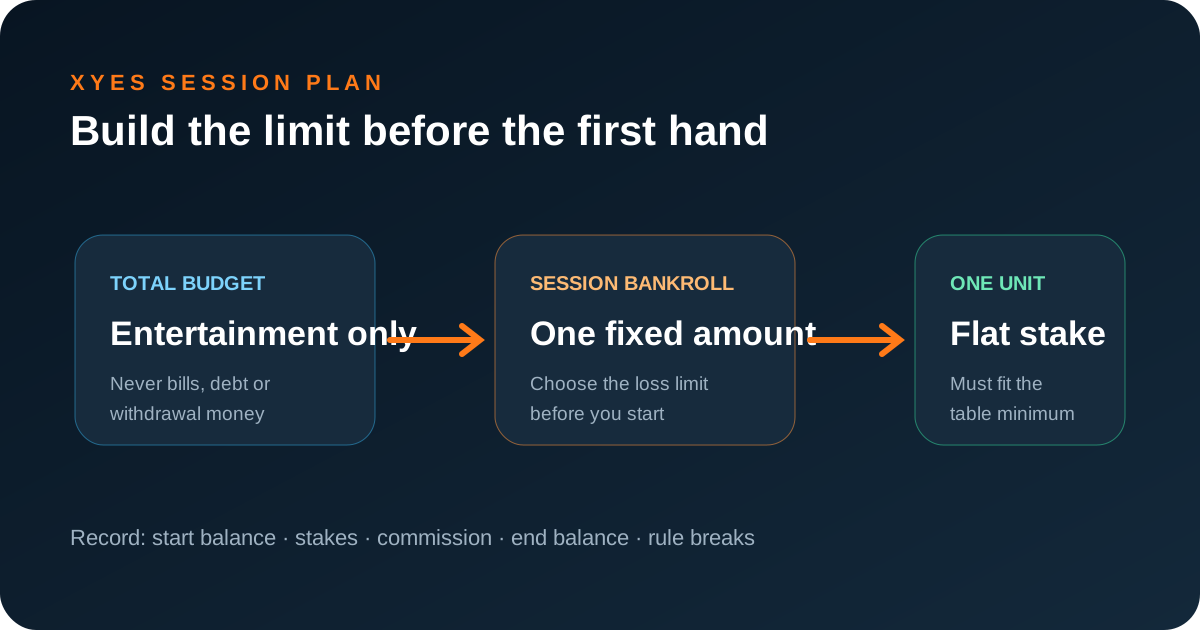
Start with money already set aside for entertainment, assign only part of it to one session, then choose a flat unit that fits both the table minimum and the session loss limit. If the minimum stake is too large, the table does not fit the plan.
- Do not use bill money, debt or funds needed while a withdrawal is pending.
- A one-unit stake should stay one unit after a loss.
- Set both a money limit and a time limit before the first hand.
- Record Banker commission separately so the end balance matches the actual statement.
USD 50 session
USD 1 unit
2% illustration
USD 100 session
USD 2 unit
2% illustration
USD 500 session
USD 5 unit
1% illustration
USD 10 minimum
Check fit
20% of a USD 50 session
First calculation
Separate total entertainment funds, one session and one betting unit
| Layer | What it means | When it changes | What it must not include |
|---|---|---|---|
| Total entertainment budget | Maximum money set aside for gambling over a chosen period | Only during a planned budget review | Bills, rent, debt, borrowed money |
| Session bankroll | Amount available for one defined period of play | At the next planned session, not after a loss | Automatic top-ups or another deposit |
| Betting unit | Default flat stake for one decision | Only before a new session or written review | Loss-chasing increases |
Total entertainment budget
- What it means
- Maximum money set aside for gambling over a chosen period
- When it changes
- Only during a planned budget review
- What it must not include
- Bills, rent, debt, borrowed money
Session bankroll
- What it means
- Amount available for one defined period of play
- When it changes
- At the next planned session, not after a loss
- What it must not include
- Automatic top-ups or another deposit
Betting unit
- What it means
- Default flat stake for one decision
- When it changes
- Only before a new session or written review
- What it must not include
- Loss-chasing increases
A redeposit is a new financial decision
If the session bankroll is gone, adding funds does not restore the original plan. It replaces the limit after the outcome is known.
Worked currency examples
What do 1%, 2% and the table minimum look like in USD?
These examples use USD for clear arithmetic, not as a universal recommendation. Apply the same percentages to your own currency, then compare the result with the displayed table minimum; a high minimum can invalidate the plan.
Calculation method: Multiply the stated session bankroll by 1% or 2%. For the real stake percentage, divide the table minimum by the session bankroll. No row is a recommended bet size.
| Session bankroll | 1% unit | 2% unit | Example 20% loss limit | Key check |
|---|---|---|---|---|
| $50 | $0.50 | $1 | $10 | A $5 or $10 minimum is already large |
| $100 | $1 | $2 | $20 | Check commission and minimum stake |
| $500 | $5 | $10 | $100 | Do not scale up only because the balance is larger |
$50
- 1% unit
- $0.50
- 2% unit
- $1
- Example 20% loss limit
- $10
- Key check
- A $5 or $10 minimum is already large
$100
- 1% unit
- $1
- 2% unit
- $2
- Example 20% loss limit
- $20
- Key check
- Check commission and minimum stake
$500
- 1% unit
- $5
- 2% unit
- $10
- Example 20% loss limit
- $100
- Key check
- Do not scale up only because the balance is larger
$50 session at a $10-minimum table
One minimum stake equals 20% of the session bankroll. Five full-stake losses use the entire amount.
- 1Preferred two-percent unit: $1.
- 2Displayed table minimum: $10.
- 3Conclusion: choose a lower-limit table or do not start.
$100 session with a $2 flat unit
A two-dollar unit leaves room for ordinary variance, but the written loss and time limits still decide when the session ends.
- 1Start balance: $100.
- 2Flat unit: $2.
- 3Illustrative loss limit: $20; do not add funds after it is reached.
Before joining a table
Use the minimum stake as a pass-or-fail check
- Divide the table minimum by the session bankroll to see the real percentage per hand.
- Check whether Banker, Player and side bets use different minimums.
- Check the maximum stake only if a progression is being studied on paper; do not use it as a target.
- A lower-limit table is not permission to extend the session indefinitely.
Side bets need their own decision
A small side-bet minimum can look harmless, but it represents a different wager with a different paytable and house edge. Do not treat it as spare change inside the main unit.
Two stopping conditions
Set a money limit and a time limit
A loss limit caps the amount exposed in one session. A time limit prevents a session from expanding simply because the balance is near the starting point.
A profit lock is also a stopping rule, not an income target. Leaving after a gain can shorten exposure, but it does not make the next session profitable or alter long-run expected value.
- Write the loss limit as a currency amount, not a feeling.
- Choose an end time and use an alarm.
- Do not move either limit after a loss, near miss or roadmap streak.
- Stop early if the written stake rule is broken.
The money and time-limit principles were checked against this support guidance. GambleAware: money, time and loss-chasing considerations before gambling
Practice recording a start balance and a fixed unit without depositing.
Virtual chips only; practice results do not predict real-money outcomes.
Make the arithmetic match
Record Banker commission instead of assuming every win pays one unit
Feature and no-commission tables may settle a particular Banker result differently. Use the paytable shown for that table rather than carrying this example into every variant.
| Event | Stake | Gross profit before commission | Commission | Net profit |
|---|---|---|---|---|
| Banker wins | $10 | $10 | $0.50 | $9.50 |
| Player wins | $10 | $10 | $0 | $10 |
| Tie on a Banker or Player stake | $10 | Push under standard rules | $0 | $0 |
Banker wins
- Stake
- $10
- Gross profit before commission
- $10
- Commission
- $0.50
- Net profit
- $9.50
Player wins
- Stake
- $10
- Gross profit before commission
- $10
- Commission
- $0
- Net profit
- $10
Tie on a Banker or Player stake
- Stake
- $10
- Gross profit before commission
- Push under standard rules
- Commission
- $0
- Net profit
- $0
The standard 5% commission example was checked against this rules reference. Wizard of Odds: standard baccarat payouts and Banker commission
Reusable session record
Keep one short record that exposes rule breaks
| Field | Write before play | Fill after play |
|---|---|---|
| Session | Date, table and planned end time | Actual end time |
| Money | Start bankroll and loss limit | End balance |
| Stake | Base unit and table minimum | Largest stake used |
| Costs | Commission rule | Commission paid |
| Discipline | Reset and stop rules | Any rule broken? Why? |
Session
- Write before play
- Date, table and planned end time
- Fill after play
- Actual end time
Money
- Write before play
- Start bankroll and loss limit
- Fill after play
- End balance
Stake
- Write before play
- Base unit and table minimum
- Fill after play
- Largest stake used
Costs
- Write before play
- Commission rule
- Fill after play
- Commission paid
Discipline
- Write before play
- Reset and stop rules
- Fill after play
- Any rule broken? Why?
The record is useful even when the session ends in profit
A positive result can hide poor decisions. Review whether stakes increased, the time limit moved or the table minimum forced a larger unit than planned.
Fill the plan before the first hand, then compare it with the actual session record.
Baccarat session record · Date: ____________________ · Table or game: ____________________
Baccarat bankroll questions
How much bankroll do I need for baccarat?
There is no universal amount. Choose a session bankroll from disposable entertainment funds, then check whether the table minimum leaves enough room for the flat unit and written loss limit.
- Start from disposable funds.
- Check the minimum stake as a percentage.
- Do not borrow or redeposit to complete a session.
What percentage of my baccarat bankroll should I bet per hand?
One or two percent is often used as an illustration for flat-stake planning, not as a guarantee or universal recommendation. The table minimum, session length and personal loss limit can make that percentage unsuitable.
- Calculate the currency amount.
- Compare it with the table minimum.
- Keep the unit flat after losses.
What is a baccarat session loss limit?
It is the maximum currency amount you decide to lose in one session before play starts. Reaching it ends the session; another deposit does not extend the same plan.
- Write it before the first hand.
- Do not move it after losses.
- Pair it with a time limit.
Should I set a win limit for baccarat?
A profit lock can define when a session ends and shorten exposure. It does not turn baccarat into income or improve the expected value of the next session.
- Treat it as a stopping rule.
- Do not chase a missing target.
- A win limit does not remove the house edge.
What if the baccarat table minimum is too high for my bankroll?
Choose a lower-limit table or do not start the session. Raising the unit to meet the minimum changes the risk plan and can use the loss limit in only a few hands.
- Divide minimum stake by session bankroll.
- Reject the table if the percentage is too large.
- Do not expand the bankroll at the table.
Should a bankroll plan include extra money for Martingale?
No bankroll can make Martingale complete safely. A one-unit sequence needs 127 units to place six losing bets and the next 64-unit stake, while a further loss would require another doubling.
- The requirement grows exponentially.
- Table limits can stop the sequence.
- Use the betting-systems comparison before considering any progression.
Sources and review
How the bankroll examples were checked
- Wizard of Odds: Baccarat basics and standard Banker commissionUsed to check standard settlement examples and the underlying bet probabilities.
- GambleAware: Advice to consider if you are gamblingUsed for the safer-gambling distinction between disposable funds, time limits and chasing losses.
Recommended next step
Test the written plan without a deposit
Choose a virtual start balance, one flat unit and an end time. The purpose is not to prove a winning system; it is to see whether you can follow the same limits through ordinary variance.
Educational examples only; virtual-chip results do not predict real-money performance.