
Quick answer
Flat betting controls stake growth; no progression changes the house edge
Martingale, Fibonacci and D’Alembert increase stakes after losses. Paroli and 1-3-2-6 increase exposure after wins. They change the path of your bankroll, not the underlying probability of the next hand.
- Flat betting is the simplest system to audit because one unit stays one unit.
- Six Martingale losses use 63 units and require a 64-unit next stake.
- Positive progressions avoid loss chasing but can return recent winnings quickly.
- Roadmaps record previous outcomes; they do not tell a system when the next win will arrive.
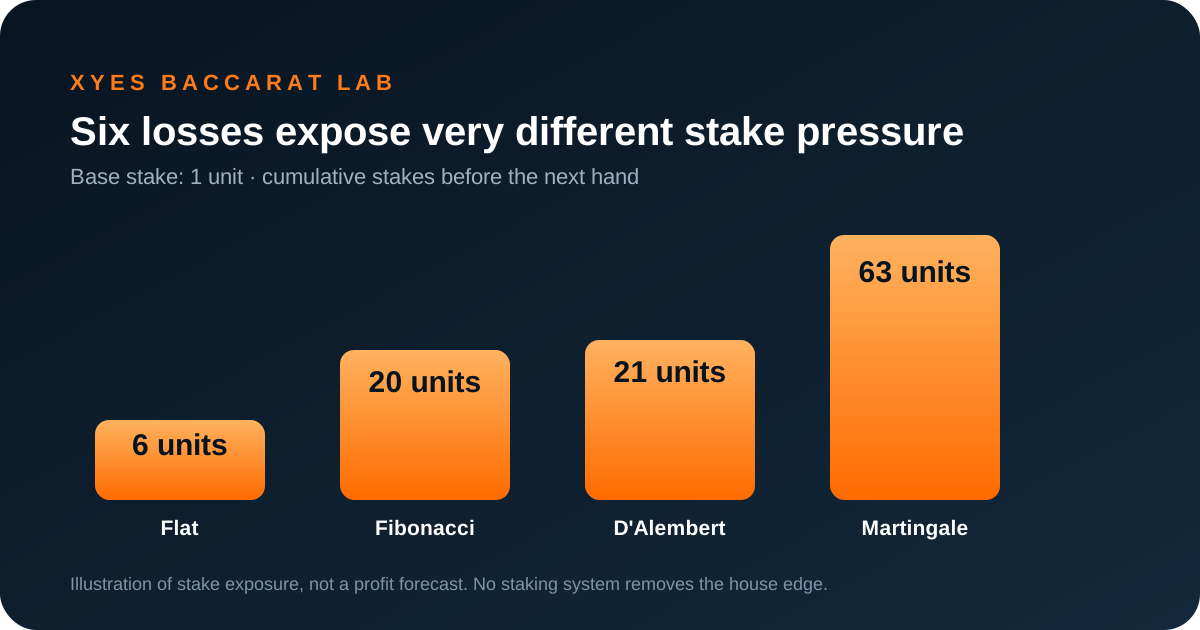
Flat: six losses
6 units
Next stake remains 1
Fibonacci
20 units
Next stake becomes 13
D’Alembert
21 units
Next stake becomes 7
Martingale
63 units
Next stake becomes 64
Start with the distinction
A betting system manages stake order, not hand probability
Banker, Player and Tie are settled by the same drawing rules no matter how much you stake. Changing from one unit to two units does not make the next Banker or Player result more likely.
A system can still change your experience. It determines how quickly stakes grow, how much of the bankroll is exposed after a streak and whether a table maximum interrupts the sequence.
Do not confuse bet selection with stake progression
Choosing Banker instead of Tie changes the underlying bet and its house edge. Doubling the same bet after a loss changes only the money at risk.
System comparison
Six common baccarat staking systems in plain English
| System | Stake sequence | Reset rule | Main pressure point |
|---|---|---|---|
| Flat betting | 1, 1, 1, 1… | No progression | Long sessions still accumulate house-edge exposure |
| Martingale | 1, 2, 4, 8… after losses | Reset after a win | Stake and bankroll requirements double quickly |
| Paroli | 1, 2, 4 after wins | Reset after a loss or target | Recent winnings remain exposed |
| Fibonacci | 1, 1, 2, 3, 5, 8… after losses | Move back after a win | A long losing run still creates large stakes |
| D’Alembert | Add 1 after a loss | Subtract 1 after a win | Slow progression can hide a growing drawdown |
| 1-3-2-6 | 1, 3, 2, 6 after wins | Reset after a loss or cycle | The six-unit fourth stake can return much of the cycle |
Flat betting
- Stake sequence
- 1, 1, 1, 1…
- Reset rule
- No progression
- Main pressure point
- Long sessions still accumulate house-edge exposure
Martingale
- Stake sequence
- 1, 2, 4, 8… after losses
- Reset rule
- Reset after a win
- Main pressure point
- Stake and bankroll requirements double quickly
Paroli
- Stake sequence
- 1, 2, 4 after wins
- Reset rule
- Reset after a loss or target
- Main pressure point
- Recent winnings remain exposed
Fibonacci
- Stake sequence
- 1, 1, 2, 3, 5, 8… after losses
- Reset rule
- Move back after a win
- Main pressure point
- A long losing run still creates large stakes
D’Alembert
- Stake sequence
- Add 1 after a loss
- Reset rule
- Subtract 1 after a win
- Main pressure point
- Slow progression can hide a growing drawdown
1-3-2-6
- Stake sequence
- 1, 3, 2, 6 after wins
- Reset rule
- Reset after a loss or cycle
- Main pressure point
- The six-unit fourth stake can return much of the cycle
Same-condition stress test
What happens when the same one-unit bet loses six times?
This table counts the six stakes already placed and shows the next stake if the system continues. Paroli and 1-3-2-6 reset after each loss, so their loss-side exposure matches flat betting.
Calculation method: Every system starts at one unit and follows only the win-or-loss rule shown in the comparison table. Total staked covers the six completed bets; the next stake is listed separately, before any Banker commission.
| System | Six stakes | Total staked | Next stake | Units needed to continue |
|---|---|---|---|---|
| Flat betting | 1, 1, 1, 1, 1, 1 | 6 | 1 | At least 7 |
| Paroli | 1, 1, 1, 1, 1, 1 | 6 | 1 | At least 7 |
| 1-3-2-6 | 1, 1, 1, 1, 1, 1 | 6 | 1 | At least 7 |
| Fibonacci | 1, 1, 2, 3, 5, 8 | 20 | 13 | At least 33 |
| D’Alembert | 1, 2, 3, 4, 5, 6 | 21 | 7 | At least 28 |
| Martingale | 1, 2, 4, 8, 16, 32 | 63 | 64 | At least 127 |
Swipe sideways to view the full table
A recovery sequence can fail before the next result
If the required next stake exceeds your remaining bankroll or the table maximum, the mathematical sequence stops. Having started the system does not create a right to complete it.
Winning progressions
Paroli and 1-3-2-6 avoid chasing losses, but still increase exposure
Paroli normally doubles after wins for a short cycle. The 1-3-2-6 system uses four predefined winning stakes. Both reset after a loss, so they do not create Martingale-style loss escalation.
The trade-off is that money won earlier in the sequence is placed back at risk. A winning progression can produce a strong short cycle, but it cannot make consecutive wins more likely.
Paroli: three wins, then reset
With a one-unit base, the stakes are 1, 2 and 4. A common rule resets after the third win rather than continuing indefinitely.
- 1Write the cycle before the first hand.
- 2Reset after any loss.
- 3Do not extend the cycle because the roadmap looks strong.
1-3-2-6: a fixed four-win cycle
The stakes total 12 units across four winning decisions. The fourth stake is six times the base unit.
- 1Use the same base unit throughout.
- 2Reset after a loss.
- 3Treat the cycle as stake management, not prediction.
Real-table constraints
Commission, table minimums and maximums break paper-only comparisons
- A standard winning Banker bet commonly returns 0.95 units of profit for every unit staked, so a one-unit win may not fully offset a one-unit loss.
- The table minimum decides whether one unit is genuinely small relative to your session bankroll.
- The table maximum can stop a loss progression even when money remains in the account.
- No-commission and feature tables may change a particular Banker payout, so check the displayed paytable.
The standard payout example was checked against this rules reference. Wizard of Odds: standard baccarat payouts, probabilities and Banker commission
Use the trainer to observe ordinary hand variance before testing any stake sequence on paper.
Virtual chips only; practice results do not predict real-money outcomes.
Before using any system
Write six answers before the first stake
- What is one unit in currency, and what percentage of the session bankroll does it represent?
- How many consecutive losses can the system fund without another deposit?
- What is the largest stake in the planned sequence?
- Does that stake fit both the table maximum and your personal loss limit?
- What exact event resets the system: one win, one loss, a completed cycle or the end of the session?
- Will you stop if you depart from the written sequence?
The most controllable answer is often the least exciting
Flat betting cannot create a recovery promise, but it keeps the next stake predictable. That makes mistakes, commission and session drawdown easier to record.
Baccarat betting-system questions
Does Martingale work in baccarat?
It can recover earlier unit losses when a win arrives before the bankroll or table limit is reached. It does not change the probability of the next hand, and six losses from a one-unit start already require a 64-unit next stake.
- The stake doubles after each loss.
- Six completed losses cost 63 units.
- The next required stake is 64 units.
Which baccarat betting system has the lowest stake risk?
Flat betting has the most predictable stake exposure because the amount does not increase after wins or losses. It still carries the house edge of the selected bet and can lose over a long session.
- One unit remains one unit.
- Drawdown is easier to track.
- Lower stake growth is not a winning guarantee.
Is Paroli safer than Martingale?
Paroli does not chase losses, so a losing streak normally resets to the base unit instead of doubling. It increases stakes after wins, which means recent winnings remain exposed.
- Losses reset the sequence.
- Wins increase the next stake.
- The underlying hand odds stay unchanged.
How does the Fibonacci baccarat system work?
A common version follows 1, 1, 2, 3, 5 and 8 after losses, then moves back through the sequence after a win. Rules vary, so write the exact reset method before comparing results.
- Progression is slower than Martingale.
- Six losses still stake 20 units.
- Different reset rules produce different records.
Can a baccarat roadmap tell me when to start a betting system?
No. A roadmap records completed results and does not change the probability of the next hand. Starting a progression after a streak still exposes the bankroll to an unknown next result.
- Roadmaps describe history.
- Streaks do not schedule the next win.
- Keep roadmap reading separate from stake sizing.
Does Banker commission affect a betting-system result?
Yes. On a standard 5% commission table, a winning one-unit Banker stake earns 0.95 units rather than one full unit. A system that assumes even-money recovery can therefore overstate the result.
- Record gross win and commission separately.
- Check the actual table paytable.
- Do not assume every baccarat variant settles Banker the same way.
Sources and review
How the staking comparison was checked
- Wizard of Odds: Baccarat basics, probabilities and standard commissionUsed to check the standard bet probabilities and the distinction between bet choice and stake progression.
- XYES Casino Blog: XYES editorial standardsExplains how calculations, corrections and commercial relationships are handled.
Recommended next step
Turn the base unit into a written session plan
The system table shows how stakes can grow. The bankroll guide checks whether the base unit, table minimum and personal loss limit can coexist before a session begins.
Educational examples only. No staking plan can guarantee a win or remove the house edge.