
Quick answer
A roadmap records the shoe; it does not predict it
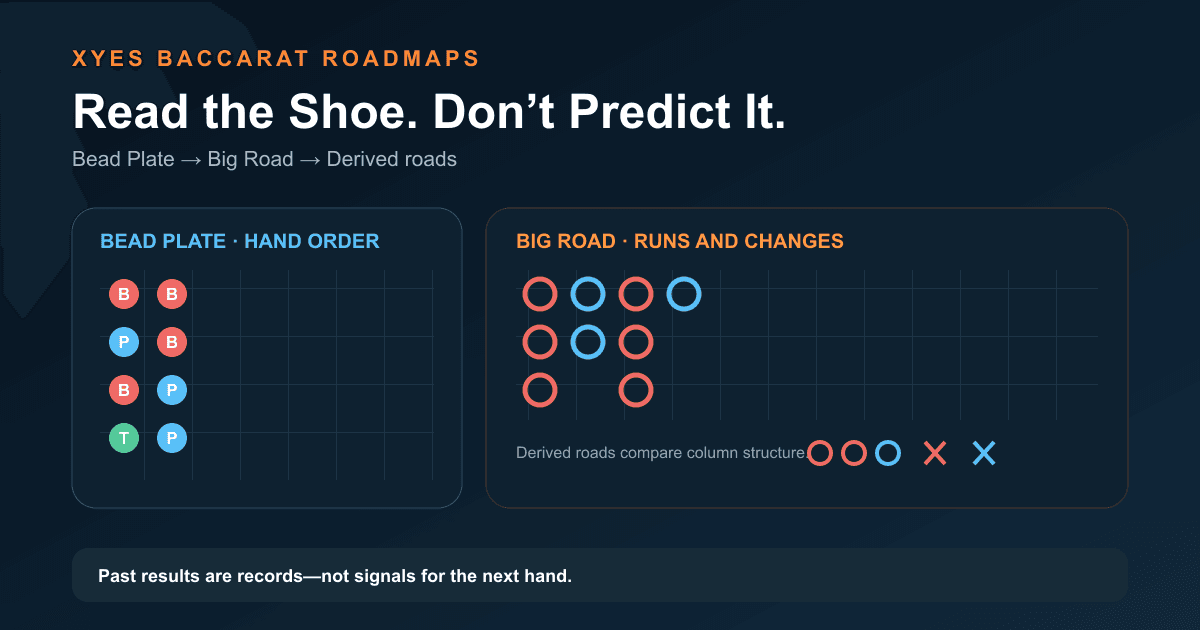
The Bead Plate records results in order. The Big Road groups runs of Banker and Player. Big Eye Boy, Small Road and Cockroach Pig compare the shape of the Big Road. These displays help with review, but they do not know which cards remain in the shoe.
- On the Big Road, red and blue normally mean Banker and Player.
- On derived roads, red and blue describe structural comparisons—not which side to bet.
- Tie markings vary slightly between table interfaces.
- The safest use is reviewing whether a pattern changed your staking decisions.
Easiest start
Bead Plate
Results in time order
Main display
Big Road
Runs and changes
Advanced
3 derived roads
Compare road structure
Key limit
No prediction
History cannot deal cards
Start with the symbols
The same colors mean different things on different roads
The most common reading mistake is assuming every red mark means Banker and every blue mark means Player.
| Road | What it records | What red and blue mean | Best beginner use |
|---|---|---|---|
| Bead Plate | Every Banker, Player and Tie result | Red Banker, blue Player, green Tie | Follow the hand order |
| Big Road | Runs and changes between Banker and Player | Red Banker, blue Player | See columns and runs |
| Big Eye Boy | Adjacent Big Road column structure | Regularity comparison | Do not treat it as a side |
| Small Road | Big Road structure with a wider offset | Structural comparison | Use only after learning Big Road |
| Cockroach Pig | Big Road structure with the widest offset | Structural comparison | Review shape, not outcomes |
Swipe sideways to view the full table
Terminology note
Interfaces may label Cockroach Pig as Cockroach Road, and some use scorecard instead of roadmap. The underlying display serves the same recording purpose.
Step one
Bead Plate: read each result in chronological order
The Bead Plate does not regroup runs. It fills one cell per completed hand, usually down a column before moving right.
Because every hand has its own cell, it is the clearest view for checking when Banker, Player or Tie occurred.
- Begin at the top-left and read down each column.
- Red normally marks Banker, blue Player and green Tie.
- Pairs or naturals may appear as smaller dots or letters.
- On mobile, older results may sit outside the visible horizontal area.
Step two
Big Road: continue down for the same side, move right when it changes
The Big Road groups consecutive Banker or Player results, making runs and side changes easier to see than on the Bead Plate.
- A repeated side normally continues down the same column.
- A change from Banker to Player, or Player to Banker, starts a new column.
- A long run may move right when it reaches the bottom or an occupied cell.
- A Tie is commonly added to the current mark rather than starting a new column.
Deal several virtual hands, then compare the same results on the Big Road and Bead Plate.
Virtual chips only; practice results do not predict real-money outcomes.
Advanced reading
Derived roads compare structure; they do not call Banker or Player
Big Eye Boy, Small Road and Cockroach Pig are derived from the Big Road. They compare column depth and shape at different offsets.
Their red and blue marks do not map directly to Banker and Player. Learn the Bead Plate and Big Road first; that distinction prevents the most costly misunderstanding.
| Road | Comparison offset | Useful for | Does not mean |
|---|---|---|---|
| Big Eye Boy | Adjacent columns | Comparing recent Big Road structure | Red means bet Banker |
| Small Road | One column farther apart | Viewing structure at another distance | Blue means bet Player |
| Cockroach Pig | Two columns farther apart | Comparing more distant column shape | A guaranteed signal |
Swipe sideways to view the full table
Table feature
Ask Road previews a drawing change, not the next result
Ask Road normally shows how the derived roads would change if the next hand were Banker or Player. It is a visual what-if tool.
It does not calculate the next-hand probability or inspect the cards remaining in the shoe. Matching colors only describe the hypothetical road shape.
A useful one-line test
Ask Road asks how the chart would draw—not which cards will be dealt.
Worked shoe
Compare the Bead Plate and Big Road across 12 results
This sequence demonstrates recording only. It is not a real-money result and says nothing about hand 13.
One result sequence
The Bead Plate enters these results one cell at a time in the same order.
How the Big Road groups it
The Big Road groups repeated Banker or Player results; a Tie is normally attached to the current position.
- 1The first two Banker results run down the first column.
- 2Three Player results open and continue down the second column.
- 3The Tie is marked on the active position; the next Banker starts a new column.
- 4The later three-Banker run forms a longer column, but it remains historical data.
Risk control
Use the chart to review decisions, not chase its shape
- A long Banker run does not make another Banker result due.
- A long absence of Player does not make Player overdue.
- Matching derived-road colors are not a three-way confirmation signal.
- A useful review question is whether a pattern caused you to raise stakes or chase a loss.
More accurate language
Within a shoe, the next outcome comes from the cards remaining and the fixed drawing rules. A chart of past outcomes cannot feed back into the deal.
Practice reading and reviewing the road without using real money to test a betting system.
Virtual chips only; practice results do not predict real-money outcomes.
Baccarat roadmap questions
Can baccarat roadmaps predict the next hand?
No. A roadmap visualises completed Banker, Player and Tie results. The next hand comes from the cards remaining in the shoe and the fixed drawing rules; the road shape cannot control the deal.
- Use roadmaps for review, not prediction.
- Runs and alternating patterns describe history.
- Avoid any system that promises guaranteed returns from a road.
What is the difference between the Big Road and Bead Plate?
The Bead Plate records hands in chronological cells. The Big Road groups consecutive Banker or Player outcomes into columns and opens a new column when the side changes.
- Both use the same completed results.
- The layouts answer different review questions.
- Start with the Bead Plate if you lose track of hand order.
Do red and blue mean Banker and Player on the derived roads?
No. On Big Eye Boy, Small Road and Cockroach Pig, the colors report a structural comparison derived from the Big Road. They are not direct Banker or Player labels.
- Colour meaning depends on the road.
- Learn the Big Road first.
- Derived roads do not create a betting edge.
How is a Tie shown on a baccarat roadmap?
On the Bead Plate, Tie normally has its own green result cell. On the Big Road, it is commonly added as a marker to the current Banker or Player position. Exact icons can vary by interface.
- Check the table legend.
- A Tie normally does not open a new Big Road column.
- Pair markers are separate from the result.
What does Ask Road do in baccarat?
Ask Road previews how derived-road marks may change under a hypothetical next Banker or Player result. It previews chart construction; it does not forecast the next hand.
- It is a what-if display.
- It does not inspect the remaining shoe.
- Use it to understand the chart, not as a probability calculator.
Sources and review
How the roadmap guide was checked
- Pragmatic Play: Live Casino Baccarat RoadsUsed to confirm that modern live-baccarat interfaces commonly provide five traditional baccarat roads.
- Wizard of Odds: BaccaratUsed to cross-check standard Punto Banco rules and probability context.
- XYES Casino Blog: Baccarat Practice ToolUsed to replay the worked shoe and verify the visible roadmap sequence.
Turn reading into practice
Deal a virtual shoe and watch each road update
Start with the Bead Plate, switch to the Big Road, and explain every new mark before dealing again. That is a more useful test than trying to guess the next hand.
Virtual chips only. The tool does not predict outcomes or guarantee returns.